- Preamble
- Introduction
- The model
- Application: Analogy
- Application: Writing
- Application: Tea break
- Application: Finding balance point
- Application: Communication & perspective-taking
- Application: The cold gaze
- Comparisons to mainstream knowledge
- Discussion
- Appendix 1: The analogies
- Appendix 2: Other thoughts
- Bibliography
Before going to the discussion section, let’s compare the theory to contemporary ones in various fields.
Cognitive psychology
Depending on the context, the clearness - fadedness continuum can be described as:
| Model | Clearness | Fadedness | Example |
| Attitude | Explicit attitude | Implicit attitude | Belief, judgement, external pressure |
| Persuasion | • Central route processing • Systematic processing | • Peripheral route processing • Heuristic processing | |
| Awareness | Consciousness | Unconsciousness | Judgement, categorization |
| Knowledge | Declarative knowledge | Procedural knowledge | Categorization, feature, attribution, proposition: FADEDNESS(clearness 1, clearness 2) |
| Attention | Controlled process | Automated process | Rumination, absentminded, slip, inattention blindness |
| Memory | Retrievable memory | Decayed memory | Prime, stimuli, tip of the tongue effect, recall, recognition |
| Logic | Stated information | Unstated assumptions |
The movement is the organization of knowledge, or the thing you observe in your self-awareness, retrospection, introspection, metacognition, etc. The perspective can be the schema, script, frame, topic, mindset, mental state, paradigm, worldview, belief, etc.
Memory
Let’s compare to the multi-store model:
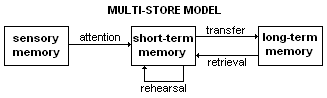
| Clearness | Retrievable memory |
| Fadedness | Irretrievable/decayed/forgotten memory, automaticity |
| New clearness registration | Transfer to long-term memory |
| Movement forming a clearness | Chunking, bottom up |
| Looking into a clearness and see a different perspective in there | Memory retrieval, top down |
| Perspective changing make the fadedness becomes clearness | Attention, long-term memory to working memory |
| Movement changing under the same clearness | Memory distortion |
Cognitive linguistics
| Fadedness | Prior knowledge |
| Movement completion registers new clearness | Concept formation |
| Movement reset | Schema change, language fluidity, clear-cut boundary becomes blurry |
| Isolated clearness | Fleeting perfect word combination |
| Unique set of clearnesses | Defining features (necessary and sufficient conditions) |
| Clearness | Fadedness | Perspective | |
| Frame semantic | Element | Frame | |
| Cognitive grammar | Thing | Relation | |
| Metaphor | Feature | Domain |
There are 5 frameworks to study communication: (1) communication as shaper of public opinion; (2) as language use; (3) as information transmission; (4) as developer of relationships; and (5) as definer, interpreter, and critic of culture. Under different perspectives the partakers will have a hard time to communicate efficiently. The perspectives are different, but they are slightly different. The clearness communication, therefore, is a polysemy.
Cognitive therapies
This is the model of CBT (image taken from Hofmann, 2012):
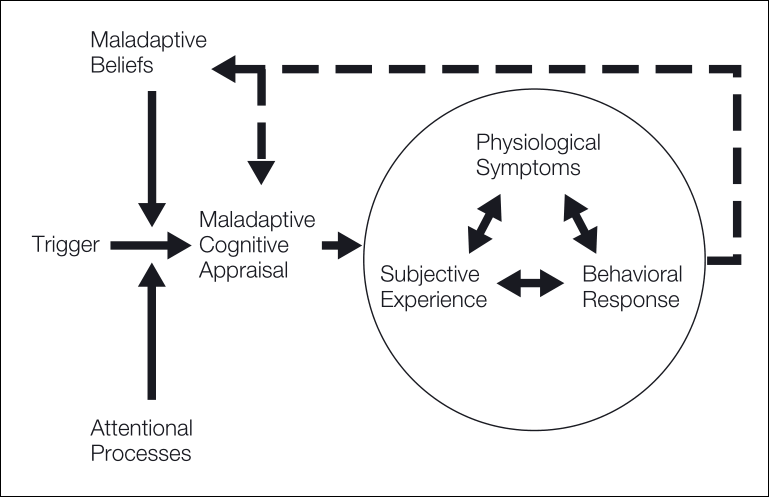
| Core belief, maladaptive cognition, misconception, impulse | Clearness |
| Automatic thought, maladaptive cognition, misconception | Fadedness |
| Identifying misconception, downward arrow technique, acceptance | Unfading a fadedness (by changing the perspective) |
| Modifying misconception | Resetting the movement |
| Acceptance, exposure | Getting into a new perspective |
| Distancing, decentering | Getting to a new perspective and looking back |
Buddhism
| Clearness | Dharma |
| Duality | Dharma is both real and unreal, impermanence |
| Movement forming clearness | Conditions produce dharma |
| Perspective | Clinging on dharma |
| Mindfulness | Being attentive of the duality of each clearness |
| Enlightenment | Movement forming and clearness registration |
| Detachment, dispassion | Getting to a new perspective and looking back |
| Reincarnation, impermanence | Chain of clearnesses |